Jaya Sri Maha Bodhi
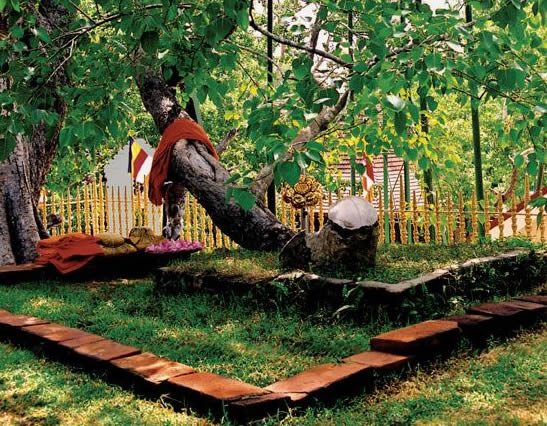
 The sacred Bodhi tree is considered to be a very sacred object by the Buddhists of Sri Lanka. It was during the reign of Devanampiya Tissa that the southern branch of the Bodhi Tree in Buddhagaya, India, where the Buddha attained enlightenment, was brought to Sri Lanka. BCE Between 307 and 267, the Sangamitta Arahathya and the Bodhi branch landed at Dambagola Patuna and decorated the road to the southern Wahalkada in Anuradhapura through the village of Tivakkala. The Mahavamsa mentions that the Bodhi tree was planted at the place where the Rajdhavaraya was located in the Mahamevnna Uyana mentioned by the Thera. Local rulers came from different parts of Sri Lanka to plant this sacred Bo tree. The Sri Maha Bodhi is more than 2,000 years old and is considered the oldest sacred tree in the world.
The Mahawamsa states that when the Bodhi tree was planted, eight buds miraculously emerged from it. They were later planted in different parts of the country. It is said that there was a waterway from Tissa Wewa to a water supply for the sacred Bo-tree and a pond built near the Lomamahapaya. Various rulers have erected various buildings on this site since ancient times. The courtyard where the Bo tree was planted was square. It was surrounded by a wall and four gates.
 The first was the Sapaladawala courtyard and the second was the sand courtyard. The Mahavamsa mentions that a stone throne and four dome-shaped pillars were installed at the south gate. King Mahanama (560 - 564 AD) made a moat around the courtyard and King Sena II (866 - 901 AD) restored it and held a ceremony. The wall around the Bodhi Maluwa was built by the Athadasasi Thero who was in charge of the Bodhi Maluwa in Anuradhapura during the Kandyan period. The wall is 338 feet from the north to the south, 274 feet to the west and 5 feet thick.
The most important architectural feature of the Bodhi tree was the Bodhgaya. The Mahavamsa mentions a Bodhi Gaya associated with the Sri Maha Bodhi. King Jetothissa (267 - 276 AD) built three pandas to the Bodhi Ghara. King Dhatusena (461 - 479 AD) rebuilt the Bodhi Tree. King Sena II (866 - 901 AD) repaired it. However, the Bodhi Tree which is attached to the Sri Maha Bodhi in Anuradhapura is not seen today. AD The Chinese traveler monk Fahien, about 412 AD, mentions the Sri Maha Bodhi. In his travelogue, it is seen that a branch which had been torn to the southeast of the Bodhi was ceremonially cut down and that the Sri Maha Bodhi was originally a shrine with a Buddha statue.
Historical sources say that eighteen craftsmen from Sri Maha Bodhi visited Sangamitta Thera with her arrival. Since then they have been engaged in various duties related to the Sri Maha Bodhi.
 About the Bodhi Tree Bodhiwansa was written in Pali by Ven. Upatissa Thera around 10th century. But it seems to have been based on the earlier work 'Sinhala Bodhiwansa'. The Bodhiwansa had many books on it. The Bodhiwansa glossary was written in Pali, with a poem and a commentary, a version and a saman in Sinhala. "Dharma Pradeepika" is the greatest literary work on the Sri Maha Bodhi. This is a work by Guru Gomumen from Dambadeniya. Detailed information on the Sri Maha Bodhi of the Sinhala Maha Bodhiwansa written by Wilgammula Maha Thero during the Kurunegala period is contained in the book. Also in the Kandyan period, the book 'Madurartha Purashana' written by Ven.
The Bodhi tree is more than 21 feet above the ground level and has three platform levels. The platform is 71 feet long and 57 feet wide. The necklace at the ground level is the sandbox. There are a number of sacred Bodhi trees that resemble the Buddha's great Maha Sangha. There are 41 of these. There are 3 tops and the rest are sandbags. The daily rituals and the annual rituals performed for the sacred Bo tree are two parts. The courtyard and other courtyard where the Sri Maha Bodhi is located, the purification of the flower seats and the temple, the prescribed Buddha pooja, the Buddha pooja with the sound of hevisi and the Gilanpasa poojas are performed daily. In addition, annual rituals such as New Rice Festival, Nanamura Festival, Old Year Festival and Karthika Mangalya are also held. The Bodhi Maluwa is currently in the custody of the Bhikkus who are descended from the Bhikkhu lineage.




 Time in Colombo


